As of August 28th, 170 billionaire families have spent over $1.7 billion to influence the outcome of the 2026 federal midterm elections. 17 of these families—who collectively gave $363 million this cycle—had direct personal or professional connections with convicted pedophile Jeffery Epstein.
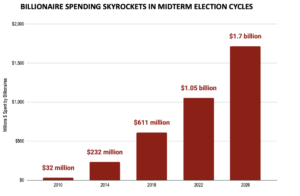
- With two months remaining in the election cycle this amount of billionaire election spending surpasses the record-breaking $1 billion they spent in the 2022 midterm cycle and is on track to double their political spending from four years prior.
- Billionaires’ political spending is up 53-fold since the Supreme Court’s 2010 Citizens United decision allowed for unlimited campaign donations.
- Twenty years ago – the last midterm cycle before the floodgates of unlimited spending were opened – the top 15 contributors spent less than $15 million in the 2006 elections. A handful of individuals now spend 6,400% more to decide who controls America’s federal government
- The vast bulk of billionaire-family political contributions went to so-called “independent expenditure” groups–which thanks to Citizens United can raise unlimited amounts from each donor–rather than directly to candidates or parties, which still work under campaign-contribution limits. Less than 20% of billionaires’ contributions went through committees with spending limits.
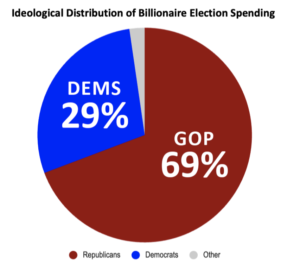
- Billionaire spending heavily favored Republicans over Democrats by over two-to-one, with $1.2 billion (69%) going to support Republican candidates so far and $488 million (28%) direct to backing Democrats.
- In addition to known billionaire political donations, there are nearly $600 million of dark money contributions from unknown shadowy sources that could include the nation’s wealthiest families and the corporations they control.
TABLE OF CONTENTS
- Introduction
- Top Billionaires Family Election Spenders
- Where the Billionaires Spend Their Money
- Tax Policy To Stop Billionaires
- Methodology
With less than two months before the midterm elections, America’s billionaire families are making sure they get their say in who we vote for. Thanks to the 2010 Citizens United ruling by the Supreme Court, the ultra rich can flood our elections with unlimited campaign contributions. Americans for Tax Fairness examined over 200,000 federal political contributions made between January 1st 2025 to August 28th 2026 and has uncovered more than $1.7 billion of campaign cash sourced directly to billionaire families and the corporations directly under their control. This is a 70% increase from what billionaires spent in the entire 2022 midterm election cycle, and up 53-fold since the 2010 midterm elections, though there were significantly fewer billionaires at the time.
The majority of billionaire money has been supporting Republican candidates. Of the 172 billionaire families in this report we found that 113 of them giving predominantly to Republican candidates and conservative outside spending groups, while 45 families backed mostly Democrats and liberal outside spending groups, with the rest spending roughly equally supporting both parties. This has translated into a more than two-to-one billionaire fundraising advantage for Republicans, with $1.2 billion (69%) going to support Republican candidates so far this election cycle and $488 million (28%) to Democrats.
Even among the ultra-rich, the bulk of campaign contributions is concentrated at the top with just 15 billionaire families spending $962 million to influence the 2026 midterm elections. Twenty years ago – the last midterm cycle before the floodgates of unlimited spending were opened – the top 15 contributors spent less than $15 million in the 2006 elections. That means over just two decades a handful of individuals are now spending 6,400% more to decide who controls America’s federal government. With the exception of the Soros family and Larsen family, all the top 15 political spenders this cycle heavily lean Republican.
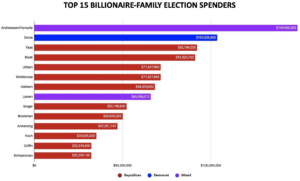
Source: Americans for Tax Fairness
Federal tax policy–which has the most direct impact on billionaire wealth–is perhaps the most obviously affected by the money-for-power billionaire bargain. Polling consistently shows large majorities of Americans, including most Republicans and Trump voters, want rich households and the big corporations they largely own to pay more taxes. Yet the general trend of tax legislation over the past 40 years has been to lower taxes on the richest people and most profitable firms. Perhaps unsurprisingly, after Republicans voted to pass a massive $1 trillion tax cut for the richest Americans, their campaign coffers are overflowing with contributions from the very beneficiaries of their policies.
While $1.7 billion is a lot of money, these families combined are worth over $4 trillion, making their political spending equivalent to just 0.04% of their total wealth. It would take 9.5 million ordinary American families contributing 0.04% of their income to politics just to match what the 170 billionaires have already spent this election cycle. For the ultra rich, spending money to influence elections is not just about ideology but a savvy investment that pays rich dividends.
Since the 2024 elections, billionaire wealth has grown over $2 trillion. This self-reinforcing combination of booming billionaire fortunes and weakening campaign-finance laws continues to threaten our democratic form of government. As the outcome of the last presidential campaign amply demonstrates, until billionaires pay their fair share of taxes and we put effective curbs on their political spending, this threat will only grow.
Source: Americans for Tax Fairness
Following the Watergate scandal of the 1970s, which among other revelations showed the corruption of federal campaign funding, Congress tried to clean up the system. But several key court decisions over the decades have frustrated that effort. The one that opened the door widest to unlimited spending on elections was Citizens United. It allowed a kind of political action committee, dubbed a super PAC, that can collect unlimited contributions from each donor. (Super PACs are not supposed to coordinate their activities with the candidates they support, but that restriction is routinely ignored.) In contrast, there are limits on how much any one donor can give to candidates, party committees and regular PACs.
Source: Americans for Tax Fairness
So it’s only through super PACs that billionaire-family political spending can find its full expression. Around 81%, or nearly $1.4 billion, of the total contributions made by these billionaire families were made to super PACs. Another $143 million, about 8% of billionaire spending, went to Party committees which have unprecedented power to influence political outcomes thanks to a recent Supreme Court ruling. That leaves just $190 million going directly to candidates, traditional PACs, and joint fundraising committees.
Biggest 2026 Billionaire Donors
#1 Andreessen & Horowitz Families (combined net worth $3.1 billion): The two men founded the Silicon Valley venture capital firm Andreessen-Horowitz almost two decades ago which has become a tech investment juggernaut managing over $90 billion and a popular location for the billionaire class including Jeffrey Epstein to park their money.
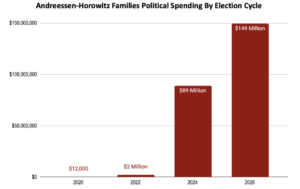
Andreessen & Horowitz have made dozens of identical donations on the same exact day to the same exact PACs. In addition to their personal political spending, they have directed their venture capital firm to make $58 million of political contributions this election cycle as of August 28, 2026. In total the duo have spent $149 million so far this midterm, up dramatically from the $89 million they spent in 2024, and the $2 million they spent in 2022.
Source: Americans for Tax Fairness
The beneficiaries of Andreessen & Horowitz spending span the political spectrum, from Democratic Congressman Richie Torres in the Bronx to Republican Jim Jordan of Ohio, but they all share one similarity in common and that is a favorable disposition to expansion of cryptocurrency and artificial intelligence in the US economy. More than 80% of their money went to just two Super PACs; Leading the Future which is explicitly pro-AI and Fairshake which is explicitly pro-crypto. These two PACs funnel their money to different Super PACs [examine tab 2] and spend lavishly on Andreessen & Horowitz-preferred candidates. An additional $18 million was given to the Trump aligned Super PAC MAGA Inc.
Based on the dispersal of Andreessen & Horowitz political spending, we estimate that they spent $6.4 million to successfully defeat Alex Bores in the Democratic primary race for New York’s 12th Congressional District and $2.2 million to successfully support Alabama Representative Barry Moore’s primary contest for the state’s open Senate seat.
#2 Soros Family (net worth $7.5 billion): George Soros, the currency trading billionaire, and his children have spent nearly $104 million on the 2026 midterm elections. This is less than the $129 million the family spent in the 2022 midterm cycle, but there is certainly time for them to make up the difference. Given the general tilt of billionaire spending towards Republicans, the Soros family is one of the few fountains of cash for Democrats this election season, representing more than 20% of their total billionaire contributions.
The vast majority of that spending ($102 million) has been directed to Democracy PAC, an outside spending group founded, and nearly exclusively funded, by the Soros family in 2019 which almost exclusively supports Democrats. Democracy PAC has transferred $9 million to the Senate Majority PAC and $3 million to House Majority PAC both of which are super PACs dedicated to supporting congressional Democrats. It also contributed $6.5 million to the Working Families Party PAC which backs progressive candidates for office. With more than $64 million cash on hand as of this writing, Democracy PAC is sure to play a major role in the closing weeks of this election cycle.
#3 Yass Family (net worth $67.4 billion): Jeffery Yass is a long time Republican mega-donor and pioneer of high-frequency stock trading on Wall Street through his financial services company Susquehanna. Yass has spent $92 million in federal politics this cycle, nearly matching the $102 million he spent in 2024. About two thirds of Yass’s contributions are directed to just 4 Super PACs; V-PAC ($20 million) which supports Vivek Ramaswamy for Ohio Governor, MAGA Inc ($16 million) a Trump aligned group, Club For Growth ($15 million) one of the leading pressure groups fighting against a fairer tax system, and the School Freedom Fund ($15 million) which backs candidates that promise to privatize public education .
According to tax data uncovered by ProPublica, between 2009 and 2018 Yass reported income of $11.4 billion and paid an effective tax rate of 17.2%. That’s just a little more than the 14.9% tax rate paid by average American families, and far lower than the 39.6% top marginal tax rate that was in place for most of those years.
#4 Musk Family (net worth $893 billion): After spending a record shattering $279 million to elect Republicans in 2024, Elon Musk and his brother Kimbal are once again pouring money into buying elections, so far spending $91 million for the midterms. Musk played a prominent role in the early months of the second Trump administration through his leadership at DOGE, where much like in business he gained a reputation for reckless and manic behavior. Despite his departure from the executive branch, his time there paid off with his wealth nearly tripling since Trump’s 2024 election.
Even though a Department of Justice document released in 2025 revealed the Musk brothers had an imminent and possibly criminal relationship with pedophile Jeffrey Epstein, Republicans are more than happy to take their money. The Musk brothers gave $10 million each to the CLF & SLF super PACs dedicated to electing GOP members to the House and Senate respectively. But the vast majority of Musk’s political spending has been directed to America PAC which spent $13 million on a Wisconsin state Supreme Court election last year and has been making mysterious transfers to LLCs such as Lex Politica and United State of America Inc after which the FEC money trail runs dry. With $52 million cash on hand, Musk’s America PAC has the potential to still play a big role in the 2026 midterms.
#5 Uihlein Family (net worth 15.4 billion): Richard Uihlein and his wife, co-founders of a Wisconsin-based industrial supplies company, spent nearly $72 million so far this election cycle. The couple has benefited mightily from Republican tax policy netting $43.5 million in a single year after the 2017 Trump-GOP tax law added a special loophole for businesses like theirs. By far the largest recipient of Uihlein political spending is Restoration of America PAC, to the tune of $58 million, which mainly serves as a shell that sends money to other GOP aligned groups. For instance, America Principles Projects was cut a $4.4 million check, Americas PAC got $3.6 million, and Women Speak Out received $5.9 million all to obscure their political fingerprints.
#6 Winklevoss Family (net worth $5.8 billion): These brothers are the founders of the crypto currency platform Gemini and relative newcomers to big money political spending. They went from making only $207,000 in political contributions in 2018 to this cycle spending $72 million to back Republican candidates. That spending has paid off, with the twins becoming repeat high profile guests at fancy White House events and an early investor in Don Trump Jr’s crypto start up. Though the brothers were once under heavy security by the Security and Exchange Commission, many of those investigations have dissolved since Trump returned to the White House. With that information in mind, it’s perhaps not shocking that more than half of the Winklevoss’s political spending—$36 million—has gone to MAGA Inc, a super PAC heavily associated with Donald Trump. An additional $21 million has gone to the Digital Freedom Fund, dedicated to backing candidates that support looser regulations on cryptocurrency.
#7 Adelson Family (net worth $33.3 billion): The widow of casino magnate Sheldon Adelson, Miriam inherited tens of billions from her husband and has spent $68 million of it this year to get Republicans elected. Of that amount $30 million went to the Republican Senate Leadership Fund and another $10 million to the Republican Congressional Leadership Fund, both super PACs. She also gave $20 million to MAGA Inc which supports Donald Trump (she has suggested a “Book of Trump” be added to the Bible). Trump has reciprocated her long time financial support, awarding Miriam the Presidential Medal of Freedom during his first term.
#8 Larsen Family (net worth $12.6 billion): Chris Larsen and his wife Lyna have spent over $16 million this cycle almost exclusively backing Democrats. However his ownership over the crypto company Ripple Labs that he co-founded, spent an additional $50 million to Super PACs and that money is split fairly evenly between Democrats and Republicans. The bulk of the Larsan Family’s $66 million in political spending went to Fairshake ($48 million) which backed pro-crypto currency candidates of both parties.
#9 Singer Family (net worth $6.7 billion): Private equity titan Paul Singer continues his eight election cycle streak of being a Republican mega donor, spending $52 million this cycle, more than double the $23 million he and his family spent in the 2022 midterms. Of that amount $14.5 million went to the Republican Senate Leadership Fund and another $8 million to the Republican Congressional Leadership Fund. In an unusual move, Singer also decided this year to set up his own personal Super PAC “STW Inc” which he has invested over $15 million but so far has sat dormant. Additionally Singer gave $2.5 million to the United Democracy Project, which attacks candidates they believe are critical of US-Israeli relations.
Singer’s fund, Elliott Management, has been held up as an example of the damage so-called “activist” investors can do to the companies they target. A 2021 report by the Communications Workers of America found that Elliott-targeted corporations take on excessive debt, cut workers and wages, reduce investment and buy back a lot of stock, which enriches investors. Though 2017’s Trump-GOP tax law showered the wealthy and corporations with favors, Singer tried to extract even more by using shell companies to get around mild restrictions on the use of the “carried interest” loophole that can cut money managers’ tax bill nearly in half.
#10 Brockman Family (net worth $25.5 billion): A newcomer to this list, Greg Brockman, the President of Open AI, and his wife Anna chipped in $25 million to MAGA Inc and $25 million to Leading the Future, a pro-AI deregulation bipartisan Super PAC. Prior to this election cycle the Brockmans appear to have had zero interest in playing a role in electoral funding. FEC records show less than $10,000 of contributions before 2025.
WHO IS BENEFITING FROM BILLIONAIRE CASH?
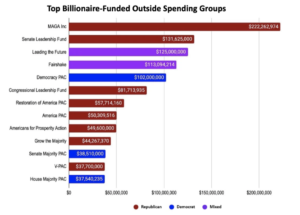
In Donald Trump’s America you have to pay to play. A large group of billionaires is sending their checks to MAGA Inc, which has raised over $222 million from them since January 2025. In fact $1 out of every $2 to Donald Trump’s MAGA Inc Super PAC comes directly from a billionaire on our list. Two massive big-tech super PACs, Leading the Further & Fairshake, have raised a combined $238 million from billionaires. They have spent lavishly to back pro-crypto and pro-AI candidates from all sides of the political spectrum.
The Republican House & Senate super PACs have dramatically outraised their Democratic counterparts among the billionaire class. SLF & CLF have raised a combined $213 million from billionaires vs Senate Majority & House Majority PACs which raised $76 million from billionaires.
Source: Americans for Tax Fairness
Top Four Senate Races, as of August 28th 2026:
Kentucky ($21,575,870 billionaire spending)
Despite dropping out of the race before a single ballot was cast , billionaires really liked businessman Nate Morris. Elon Musk cut a $10 million check to the pro-Morris Fight for Kentucky super PAC. However, following Donald Trump’s endorsement of Rep. Andy Barr, Morris dropped out of the race (he is currently nominated to be ambassador to Columbia).
Illinois ($19,997,964 billionaire spending)
The Democratic primary for this open Senate seat was a true battle between big-tech billionaires vs hotel conglomerate billionaires. Lieutenant Governor Julliana Stratton – the winner of the eventual primary – was given a nearly $11 million boost from the billionaire Pritzker family, most notably the incumbent Governor J.B. Pritzker. However her primary opponent Rep. Raja Krishnamoorthi had the backing of more than $8 million of pro-crypto billionaire spending in his quest for the nominations.
Michigan ($17,340,863 billionaire spending)
Democratic nominee Abdul El-Sayed won his Senate primary with almost no help from billionaires, a little over $100k from them, but he faced down nearly $5 million of billionaire outside spending and an additional $22 million of dark money attacks whose origins are unknown. Just weeks into the general election, Mike Rogers, the Republican nominee, has already had billionaires spend $11.7 million on his behalf.
Texas ($14,796,922 billionaire spending)
Texas Attorney General Ken Paxton was not the billionaire donor class choice for the Republican nomination. Billionaires spent $5.7 million attacking Paxton in the leadup to the spring primary and $1.2 million supporting incumbent Senator John Cornyn. So far billionaires have only spent $462,000 on Paxton’s behalf, five times less than his Democratic opponent James Talarico has gotten ($2.6 million) from billionaires so far. However, with MAGA Inc scheduled to spend $49 million in this race – of which we estimate 52% comes from billionaires – Paxton will likely overtake Tallarico in billionaire spending by a wide margin in the general.
Top House Races:
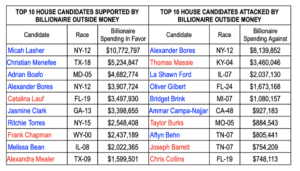
Billionaires’ spending in House races to date has mostly been in competitive primaries. The two biggest antagonists of the billionaire class were Alex Borris—who helped authored New York’s AI regulations—had over $8 million of billionaire spending against him, and Rep. Thomas Massie–who played a critical role in forcing the release of the Epstein files– had $3.5 million of billionaire spending against him. Victories Democratic primary nominees Michal Lasher (NY-12) and Christian Menefee (TX-18), Adrian Boafo (MD-5) received the most outside spending help from billionaires this primary season, though given these are all safe blue seats we expect them to be overtaken by competitive races in the coming weeks.
Source: Americans for Tax Fairness
State Billionaire Spending Fact Sheets: [Link]
FIXING TAX POLICY DISTORTED BY & FOR BILLIONAIRES
The alarming capture of the federal establishment by billionaire interests has widespread implications, ranging from our nation’s role in the world to the future of ordered democracy. But the most elemental goal of Trump, Musk and their fellow billionaires is to preserve and grow their fortunes. They believe they can do that both by demolishing large parts of the government they are supposed to be serving–thereby reducing in the long run the demand for tax revenue–and more directly by distorting the tax code further in their favor.
Among the parts of the tax system that most deeply impact billionaires and other members of the hyper-wealthy class are the estate tax; the treatment of unrealized capital gains; the pass-through loophole; and the tax breaks enjoyed by private equity. In all of these areas, tax law already favors the ultra-rich, but billionaires are ever vigilant to any threat and are always trying to bend it more their way.
Estate Tax
The estate tax has been systematically weakened by conservative politicians all through this century. The amount of family fortune exempt from the tax has expanded while the tax rate on the remainder has generally shrunk. The family of someone dying in 2002 would pay an estate tax of 50% on assets over $2.5 million. The family of someone dying in 2025 faces an estate tax of 40%, and only on assets worth over roughly $14 million–with that exemption amount rising each year with inflation. (Because of a rule change in 2011, the estate tax exemption for married couples is now best understood as a combination of each spouse’s individual exemption–so, for 2025, $28 million.)
As a result of the weaker rules, estate tax revenue remained essentially flat over the 22 years between 2002, when $21.4 billion was collected; and 2024, the latest year with available data, in which the figure was $23.3 billion. Over that same span, the U.S. economy and federal revenue in general both more than doubled in size; the collective wealth of the nation’s billionaires was up about fivefold.
The 2025 Trump-GOP tax law dealt the most recent blow to the estate tax, by doubling the exemption from $14 million to $30 million per-couple. This will cost $212 billion over the next decade in reduced revenue for the federal government and instead $212 billion going exclusively into the pockets of the nation’s wealthiest families. But Republicans are not content to simply weaken the estate tax–they want to wipe it out altogether. Scarcely a month into his new job as Majority Leader of the U.S. Senate, Republican John Thune of South Dakota introduced a bill with the co-sponsorship of practically his entire caucus to repeal the estate tax. If his bill became law, billionaire families would potentially save trillions of dollars.
Those savings are described as “potential” only because the nation’s richest families have already effectively repealed the estate tax through the use of aggressive tax-avoidance strategies. By obscuring the ownership of assets through special trusts, low-balling asset values by manipulating appraisals, and other accounting maneuvers, family dynasties pass along huge fortunes largely tax-free, which then snowball down the generations. It was estimated three years ago that the nation’s wealthiest clans could save over $8 trillion in estate and other transfer taxes over the subsequent couple of decades through these tax-dodging strategies. That figure has only ballooned since, along with the wealth of billionaires.
A government free of undue billionaire influence and instead representing the interests of ordinary Americans would begin by allowing the somewhat more stringent estate-tax rules to return on schedule in 2026. Then, instead of abolishing the tax, such a government would strengthen it with lower exemption amounts and higher rates on the largest fortunes. And lastly, it would close the loopholes and shut down the dodges so that the nation’s most fortunate families shared some of their good fortune with everyone who is not ultra rich.
Unrealized Capital Gains
“Unrealized capital gains” are the profits on unsold investments. Any asset worth more than its purchase price–from a comic book to a house–that increases in value has a gain. However, the great bulk of such gains are held by the super-wealthy. A recent ATF analysis found that the 64,000 households in the U.S. worth $100 million or more held $8.5 trillion in unrealized gains–or more than one in six dollars held by all 130 million families in the nation.
Unrealized gains are never taxed. They accumulate untaxed when held by the original owner, and then completely disappear for tax purposes when inherited. For most people, an unrealized gain is not income because they can’t spend a paper profit and therefore wouldn’t expect to be taxed on it. But at the levels held by the super-wealthy, such gains can be nearly as good as a paycheck. That’s because the superwealthy can borrow against their gains at favorable terms and wind up paying much less in interest than they would have paid in capital gains taxes if they had sold their winning investments.
Senate Finance Committee ranking member Ron Wyden (D-OR) unveiled a plan to annually tax the unrealized gains of the nation’s handful of wealthiest households. When Wyden first released his plan in 2021, Elon Musk was among the billionaires immediately attacking it.
Methodology:
We examined all contributions (and refunds) of $2,000 or more made in 2025 and 2026 up to August 28th in order to identify the billionaire families by cumulative contributions.
Families were included even if—as in the case of the Mellons and Millstones—no individual member is worth a billion dollars but the whole family is. We included donations from corporations or nonprofits if they were under the direct control of a billionaire family. For instance, contributions by Koch Industries were included since the family owns a controlling 84% of the company. Contributions by the Bloomberg Family Foundation were considered spending by the Bloomberg family since they provided 99.3% of all donations to their foundation. However, political donations from corporations like Apple and Amazon–though founded by billionaires who still own huge stakes in them–were not included in our analysis because no single billionaire family has direct majority control over them.
We assume the share of billionaire spending by super PACs is identical to the share of billionaire donations received. In calculating billionaire donations, we include not only the amount billionaires directly contributed to each committee, but also include transfers from other committees that have billionaire backing. An example of a beneficiary of this “once-removed” type of funding is the super PAC WinSenate, which spent over $300 million in the 2024 election cycle. It did not report a penny of billionaire contributions, yet we counted its share of billionaire spending at 19.9% because all of its funding came from the Senate Majority PAC, which got 19.9% of its funding from billionaires.